
My full house
It's a bit embarrassing
The other day, my niece Liat asked if she could see something I have in my basement.
A seemingly simple question, yet I found myself stuttering through flimsy excuses to avoid revealing what’s happening in the lowest level of my home. It’s not that there’s anything nefarious down there; it’s that over the years I’ve accumulated three unfinished-basement rooms full of other people’s belongings, rendering the cellar essentially unnavigable.
Call it a mess or an accidental museum. Both are true.
The first time I sorted through the stuff of someone else’s life, I was in my 20s. Days after my bubbe died in her sleep, my mother and I boxed up her apartment. We were decidedly more task oriented than nostalgic as we sorted through dresses and dishware. The building management had set a deadline, so we boxed up most of the stuff and moved it to my mother’s storage unit.
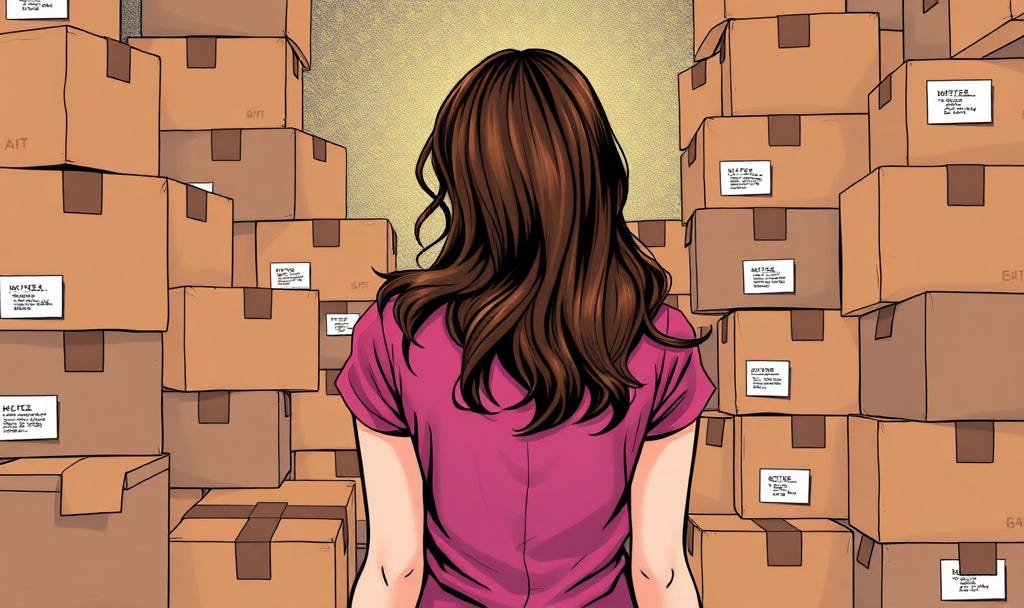
The last time I had this responsibility was nearly four years ago, after my 17-year-old daughter, Dalia, died. This time, every item, from mismatched socks to nail polish, held meaning. Where we bought this sweatshirt or that hat; how we snuggled under the pile of fluffy throw blankets; every stuffed animal’s complex backstory. I could take as much time as I wanted, and I did. At least half of Dalia’s things remain exactly where they were the morning she died.
In between my grandmother and my daughter, I lost both of my parents and my two sisters. Each time, I was the one left to decide what to keep, donate, toss, or store.
Somewhere along the way, I realized this isn’t just a practical task. It’s actually a privilege. But the problem is the collision of three competing factors: the desire to keep every single memory, the reality of space limitations, and the inevitability of emotional and energy depletion.
One of the most useful pieces of advice came from my friend Liz, after she stumbled (literally) on a box of my sister Rachel’s old photo albums crammed in the back of my closet. I couldn’t bear to throw out the albums, but when I actually looked at the pictures I realized they were full of people I didn’t know doing things that might have meant something to Rachel, but not to me.
“They’re her memories, not yours,” Liz said. I realized I wasn’t honoring Rachel by keeping the albums, and I wouldn’t be betraying her by throwing them out.
I’m not a procrastinator by nature, but I’ve definitely erred on the side of “I’ll deal with it later,” when it comes to deciding what to do with my loved ones’ belongings.
Those boxes from my grandmother’s apartment? They’re still unopened, nearly three decades later. They’re nestled next to boxes of my father’s recordings of Verdi’s Requiem, which I’d intended to give to people he loved. That beautiful intention is now more than 10 years old and unfulfilled. I have boxes of his photographs and hundreds of his books in the basement, too. I’ve yet to empty the drawers of my mother’s roll-top desk. She died in 2007.
I know of course, that the most important memories are the ones that live in our minds and our hearts, not on the basement shelves. But I also know that the “stuff” of life can make us feel connected to our people. The sweater she wore, the music he loved, the dishes they used for special occasions can help us feel close to them.
But they can’t do that from a box in the basement.
Also, I don’t need 77 versions of Verdi’s Requiem (truly) if I’m in the mood to listen to music my father loved. One would suffice. I don’t need every one of my mother’s cookbooks — especially because I don’t cook. But I may need all of my sisters’ sweaters.
Sometimes distance allows us to see more clearly what we really want to hold on to. (See what I did there? Procrastination justified.)
I’ve been thinking about all this as I write about how we stay connected to the people we’ve lost — whether through ritual, tradition, spirit, science, or the stuff that mattered to them. I do know that curling up under my mother’s purple throw wearing Dalia’s fuzzy socks has been a pretty cozy place to be these last few blizzardy days.
If you’re facing the task of going through someone’s stuff, read my new article in Psychology Today about how to make the job more manageable.
Thanks for being part of this community. I’m so glad you’re here.
With grit and grace,
Jessie